The King of the Swans
By Austin Ratner
The summer that Christian came to the day camp, three swans also came. We had never had swans at the camp’s pond before. We had ducks, and in the trees there were grackles with sparks of green in their black feathers, and there was a muskrat who paddled humorously through the muddy water, but no one had ever seen swans. It was as though the big white birds had flown across the Ohio woods just to visit the little Russian orphan boy, who was so troubled.
Jane, the camp director, always assigned me the troubled kids, maybe because I wanted to be a doctor. She knew me when I was a troubled child myself, which wasn’t all that long ago, and she knew I’d be sensitive. The previous summer I’d had a homesick kid who cried every day, another kid with leukemia covered in big brown scabs, and a kid who lied all the time. I didn’t know how to help any of them, but I wanted to. The camp director was right about that. I had just turned 16, and I thought maybe that summer I could do more. I thought maybe I could help Christian.
The camp was on a small farm about a half-hour drive south of Cleveland. In addition to games of Capture the Flag and Red Rover, the kids got to do certain jobs on the farm, like milking the goats, pressing curds in cheesecloth, and putting the goat cheese in plastic tubs to sell in the little store up by the white front gate. A dirt road led down from the gate to a barn, and beyond it to the plywood shacks on stilts that housed the camp. Past the shacks, the road ended in a dusty parking lot and a split-rail fence beside the pond. The pond was possibly man-made, but the mallard ducks considered it a real pond and so did the bigtooth aspens who’d gathered around it in large numbers on the opposite side. The aspens’ white bark was full of notches that looked like dark, hooded eyes gazing from the other side of the pond and the trees leaned and whispered in the wind in a way that made you feel both happy and lonely.
It was a nice place, run by the social workers at the JCC. They took in charity cases and kids whose families couldn’t pay. Christian was a charity case. He’d come from an orphanage in Russia, somewhere near Novosibirsk, and had been adopted by a family in Cleveland at around the age of three, but the adoption had failed. Supposedly, he was seven now, but the social workers told me in strict confidence that he was probably older. From looking at him, I would have guessed he was five or six. He was small due to malnourishment, they said. They said it was good that he looked so young because the younger his official age, the better his chances of being placed with a good family. He lived in a group home, where he exhibited troubled behaviors, the social workers said, like wetting his bed and night terrors, staring at walls, refusing to eat, refusing to talk. A psychiatrist was trying to help him stop all that so that maybe he could be placed with a new family, but it wouldn’t be easy. At the orphanage in Russia, he used to cry all night and no one would come. That was all they knew about him. I wrote it all down in a red spiral-bound notebook.
There were several coincidences concerning Christian and his constant companions, the swans. These coincidences imbued Christian with a peculiar aura of magic, though I didn’t know whether it was good magic or bad. Not only had Christian and the swans come to the camp the same summer, but there was also the coincidence of the boy’s name. He shared it with Hans Christian Andersen, author of the most famous tale ever written about swans, “The Ugly Duckling.” Then there was the coincidence that Christian refused to talk and so did his swans. There are two kinds of common white swans — trumpeter swans and mute swans. Trumpeter swans have black bills without a knob on them and they honk. Mute swans have orange bills with a big black knob on top and they make no sound at all. Christian’s swans were mute swans.
When I met Christian on the first day of camp, he was standing in the water with his shoes on, holding a curved stick up before the three enormous birds like a very small king proclaiming to some new subjects in a land he’d just invaded. The first day of camp always made me homesick, even at a day camp, even as a counselor. The first day called up a stormfront of old feelings about my father’s death and painted everything black with permanence, tragedy, and the intractable necessity of carrying on. I figured maybe Christian felt something similar.
“Christian,” I said, “what are you doing in the water?”
He didn’t answer.
My co-counselor Beth came to the water’s edge. She had a sunny, blond, open face with eyebrows so light they were almost invisible.
“They’re beautiful aren’t they, Christian?” Beth said. “We’ve never had swans here.”
Christian didn’t turn or answer, and he kept his stick held up high. The swans worked their long powerful necks with swooping gestures like they were controlled by pulleys and strings. They were as tall as he was.
“You’re getting your socks all wet, honey,” she said. She could be very sweet. When we were alone she cursed like a sailor.
From the pens up the hill came the vaguely human-sounding cry of a goat and the farmhand Campo’s low voice talking to the other children.
“Would you like to help milk the goats?” I asked. “The other kids are milking the goats with Campo.”
No answer.
“We’re going to arts and crafts after milking the goats, Christian,” Beth said. “We could make a painting of the swans?”
Beth and I looked at each other.
“Jane said he doesn’t have to,” I said. “You don’t have to, Christian. Would you like to feed the birds? I could get some bread from the kitchen.”
The little boy suddenly stabbed me with his ice-blue eyes. Then he whirled back to the water and thrust out his stick-scepter, nearly striking one of the swans with it. Two of the swans reared back and made themselves large with their immaculate white wings. The other, who’d been feeding off the bottom, whipped its head out and chopped at Christian with an unafraid meanness, but Christian didn’t flinch. He rotated the scepter around in the air, but otherwise didn’t move. The ducks quacked and flapped, then settled into new positions farther away. Mute swans really are mute and water really does roll off a duck’s back.
“You should be careful, Christian,” I said. “The swans could hurt you.”
Christian walked out of the water in squishing shoes. He hadn’t appeared moved by the commotion of the birds, but he was breathing hard as he waved his stick in the air like a baton.
“I’ll get the paints ready,” Beth said.
She started up the road to the art shack. Ghosts made of dust stood up on the dirt road and whirled around.
He stood there panting. Then, suddenly, he spoke.
“It looks like them,” Christian said in a high, panting voice. He had turned his back on the pond and the swans and held his wooden scepter out for me to look at.
It was indeed curved like a swan’s neck, and the end looked like a swan’s head with a knob on the bill.
“Thank you, Christian, for showing this to me,” I said. “It’s a special stick.”
“It has magic powers,” Christian said.

Whitney Lynn, Out of sight, out of mind (detail from WINE DARK SEE installation), 2021, ink on tight weave vinyl mesh, 6' x 12'.
–––
After that, Christian would sometimes talk to me while he fed the birds or talked to them or yelled at them in Russian or drew circles in the mud with his stick.
“Are the swans your friends?” I asked him.
They didn’t act very friendly. They ignored the birdseed that Christian threw in the water and ruthlessly plowed over the ducks when the ducks were in the way. They were not only mute but had dull expressionless eyes that looked at you one at a time. They dug at the bottom of the pond with ferocious quivering necks or floated silently on the placid water and occasionally rooted into their own feathers with their hard orange bills.
“I don’t know,” he said, as if it were a crazy question.
“What about the ducks,” I said.
“I don’t care about the ducks,” Christian said. “The ducks are mean.”
“To you?”
“They’re mean to each other.”
The pockets of Christian’s shorts were turned inside-out and birdseed dribbled from his small fist.
“The swans look so soft I want to take a ride on one.”
“Do you talk to them? Do they speak Russian?”
“I talk to them,” Christian said. “But they don’t talk back.” He came out of the water, sat down in the mud and with a great struggle began to pull off his socks and shoes.
“Here, I can help you,” I said.
He let me pull his wet socks off. He’d been standing in the water again and his feet were all red.
“Do you get mad at them for not talking to you?” I asked. “Sometimes you look like you’re mad at them. Sometimes I hear you yell at them.”
“I’m not mad at the swans for not talking,” he said. “I just imagine the things they say.”
“What do they say?”
“They tell me where they go.”
“Where do they go?”
“They go to visit other boys.”
“They have other friends like you at other ponds?”
“They’re not supposed to,” he said. “But they do.”
“I see,” I said, but I didn’t. “When you yell at them, you’re not mad?”
“No,” he said, and yawned.
“Are you tired?” I said.
“No,” he said, and yawned again.
“You look tired,” I said. “Come sit down with me over here.”
He looked around as though for some other place to lay his head, and finding none, he slid himself across the grass. He then leaned himself against me and proceeded to suck his thumb.
The next day, he came with me into the art shack. He didn’t talk to the other kids, but he glued some googly eyes on a popsicle stick. The day after that, I was able to convince him to lay down his swan scepter and take a turn at Red Rover — the running part, if not the holding hands. Jane said I was a miracle worker. She said she told Christian’s psychiatrist about his progress and that it could help him get placed with a family. I felt proud.

Shirin Khalatbari, ~88.5 cm2 of developed area, 2018, selectively developed Silver Gelatin Print, 20" x 16".
–––
On Fridays, we helped Campo the farmhand with weeding and planting and we gathered in the barn. I liked it in there. It smelled of fertilizer. It smelled like a farmer calling his plants to life, and it had that dim secrecy and quiet of a church. The kids destroyed the quiet, but it always came right back the moment they left, like a hardy plant that regrows the moment you cut it.
There was a laurel bush that grew near the goat pens, and Campo said the goats were not supposed to eat laurel and he wanted the laurel bush gone.
“If the goats eat that,” he said, “they gonna get sick. Then everybody gonna blame the Mexican.” That was like his motto, a line he often repeated: “Everybody gonna blame the Mexican.”
I laughed. Campo was from Colombia.
“I thought goats can eat anything,” I said.
“Every animal has its poison, even goats,” he said. “Even the laurel bush. You the poison for the laurel bush. Get to work! Kill it good!”
It was hard work taking down the bush, and the kids were no help at all. The girls made cat’s cradles with orange yarn from the art shack. The boys drank Capri-Suns and played tag and accused each other of cheating. I kept having to end the game and start a new one. Christian did not like the commotion, and he had no interest in the goats. I didn’t have time to spend with him alone, and he went back to the swans. Beth went with him.
It wasn’t in my nature to leave a job half-finished. I worked up a good sweat, hacking at a root system as knotted and tough as a rope hammock.
Every time Campo passed he said, “That’s good, that’s good,” approving of my progress without noticing how little I’d made.
I could not get through the laurel’s taproot, even with a handsaw. The root was too fluid and vivid with life and when Beth came running up the dirt road, kicking up flying pennons of dust, the laurel bush was still there.
“He killed a swan,” she said gravely.
Her shorts were hiked up so that I could see the scar she’d told me about high up on the inside of her thigh. It was the reason she wouldn’t ever go swimming. It occurred to me: A scar is the damage the wounded flesh does to itself.
–––
Campo brought me a wheelbarrow with a black drum liner lying over the side, flapping in the breeze. He said I was already dirty.
“You just don’t want to do it.”
“I don’t like birds,” he said. “Why you think we don’t have chickens?”
Somehow, one always manages to do something formerly inconceivable, like stuffing a dead swan into a garbage bag. I had to really wrestle with its neck, which was about as thick as the wide end of a baseball bat and dense with muscle like an eel. I did not like the look of its dead eyes or the ugly insides of its open mouth. It was lighter than I expected, no more than 20 pounds.
I tried to talk to Christian in the office, but he wouldn’t say a word. He pulled his feet up onto his chair and rested his head in his hands in a way that stretched his eye open.
“Don’t do that to your beautiful face,” I said.
The social workers called a psychiatrist named Dr. Mott who had apparently worked with Christian at the group home. She wanted to talk to me and Beth. We sat down with her in the art shack.
Beth sat cross-legged on the chair, which somehow established a kind of perimeter around her, her own small but defensible territory at the table, and told how Christian had started swinging the stick through the air, far enough from the swan not to hit it, but close enough to anger the swan, and it had flapped forward and nipped at him, and Christian had brought the scepter down on the swan’s neck, and there was a lot of splashing and more swinging of the stick and then the swan was dead.
“You’re certain it wasn’t an accident?” Dr. Mott asked.
“Well, it started as an accident,” Beth said.
“And then he was defending himself, right?” I said.
“But you didn’t see it?” Dr. Mott asked me.
“No.”
“Was he upset afterward?”
“Of course,” Beth said.
“But he didn’t cry, correct?” the psychiatrist said.
“Where are you going with this?” I said.
“He never cries,” Dr. Mott said as she made more notes.
“So what if he didn’t cry?” I said. “You want him to cry and show remorse or something? Because he’s a sweet kid. I got him to talk to me.”
The psychiatrist looked up from her notes. Her eyes, like Christian’s, were intensely blue. Her gaze was full of experience, not just professional, I sensed, but unknown emotional experience of her own. It was as though her eyes hadn’t always been blue but had been turned that color by the purifying influence of terrible things.
“You’re the one who wants to be a doctor? What’s your concern?” she asked. I couldn’t tell if there was hostility or defensiveness in the questions.
“He’s not a sociopath,” I said.
“No one’s saying that,” she said.
“But you said he didn’t cry. And I think it maybe was my fault because we’d started to form a kind of relationship, he was following me around, and then today I was busy.”
“I meant I don’t think he can let himself cry,” the psychiatrist said and went back to making notes.
I followed Dr. Mott out of the art shack to her car near the pond. The swans had gone.
“What’s gonna happen to him?” I said.
“Somebody’s gonna come pick him up, bring him to the hospital.”
“You’ll be able to help him? He’ll get placed with a new family, right? He’s gonna be okay, right?”
But even before she answered I knew. There is no such thing as original sin but there are wounds so close to the beginning, so near the tangled taproot of life, they must be called original.
“Some kids never get a chance to be young,” she said, and shut the car door.
As Dr. Mott drove away, Beth came out of the office. Our eyes met and we shared a vague acknowledgment that something bad had happened, something that eluded words.
“We have to get the other kids ready for swimming,” she said.
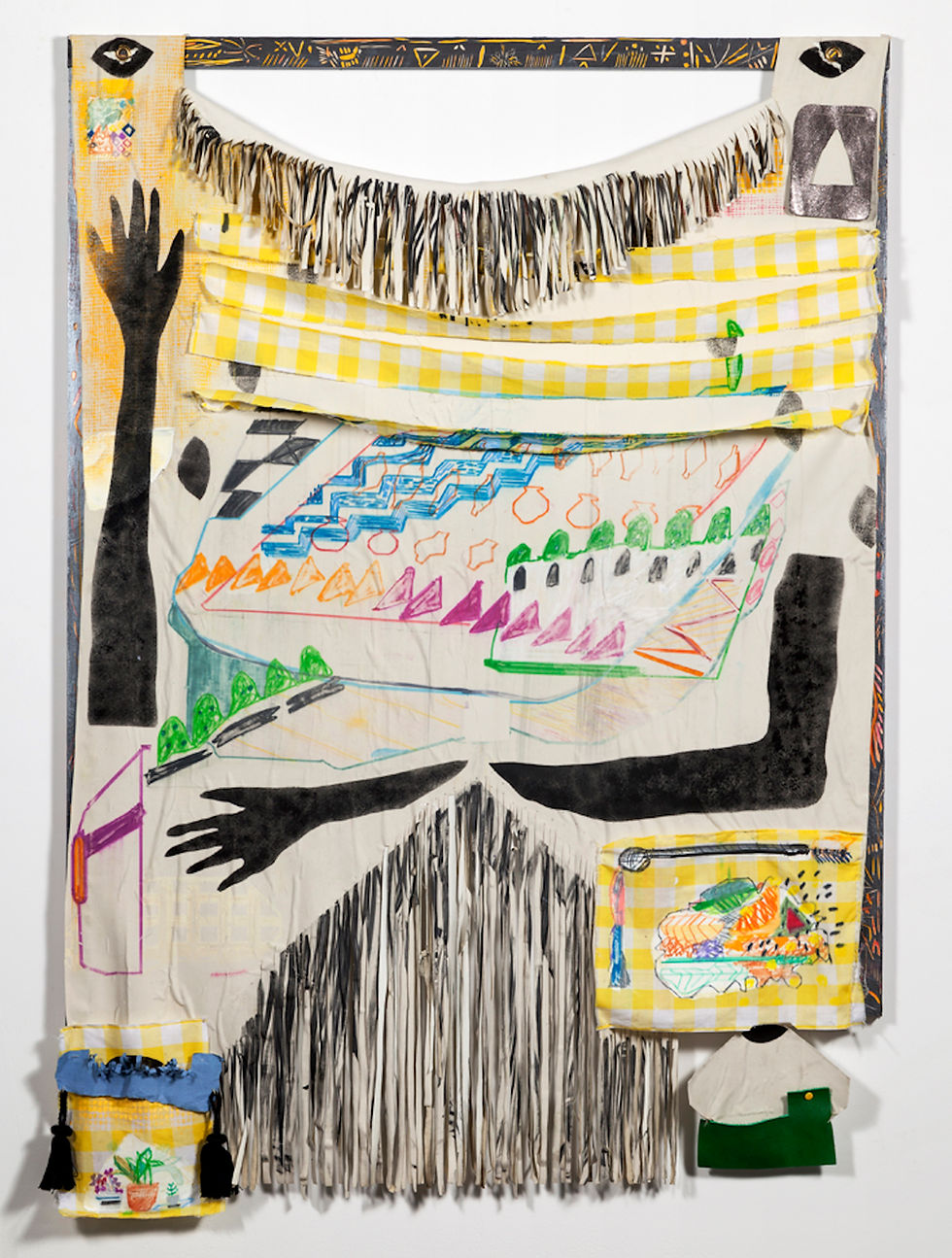
Padma Rajendran, In the Midst of Ruins, An Earthen Cave is a Palace, 2015, Pochoir, acrylic, fabric, leather, yarn on suede, textured vinyl and carved wood, approximately 60"x 40".
Austin Ratner is author of the novels In the Land of the Living and The Jump Artist, 2011 winner of the Sami Rohr Prize. His short fiction has been honored with The Missouri Review Fiction Prize and his essays have appeared among other places in The Wall Street Journal, LitHub, The Millions, and The New York Times Magazine, which selected his essay “Sidewalk Phantom” in 2017 as one of their all-time best Lives columns. He is former editor-in-chief of The American Psychoanalyst, where he now serves as contributing editor. He received his M.D. from Johns Hopkins, attended the Iowa Writers’ Workshop, is a father of two, husband of one, and generally a nervous wreck.
Whitney Lynn has staged performances at SFMOMA, Yerba Buena Center for the Arts, and the de Young Museum; screened videos at venues including the Corcoran Gallery of Art and El Espacio 23; and created public artworks for the San Diego International Airport, Reno City Hall, and Seattle’s Burke-Gilman Trail. She was the inaugural National Artist-in-Residence at The Neon Museum in Las Vegas and has completed residencies at institutions such as the Internet Archive and the Jack Straw Cultural Center. Currently, she is an Artist Fellow with Black Cube, a nomadic museum for site-specific public art. Born on a military base in Arizona, Lynn studied at the San Francisco Conservatory of Music, earned a BFA in Sculpture and Extended Media from Virginia Commonwealth University, and an MFA in New Genres from the San Francisco Art Institute. She is now an Associate Professor of Photo/Media and New Genres at the University of Washington.
Shirin Khalatbari is an artist, archaeologist, activist, and educator born in 1987 amidst the Iran-Iraq war and airstrikes, and raised in Tehran, Iran. In 2009, they relocated to Italy, where they earned both their bachelor's and master's degrees in Near Eastern Art and Archaeology from La Sapienza in 2014 and 2016, respectively. Upon immigrating to the Bay Area in 2016, Shirin pursued their MFA at San Francisco State University, graduating in 2019 with the Graduate Award for Distinguished Achievement. In 2018, Shirin was honored with the Murphy Award, a recognition that bolsters the progressive visual arts movement unique to the Bay Area. They have exhibited internationally in California, Italy, and Iran. In their artistic practice, Shirin delves into the repercussions of colonialism in West Asia. In 2019, Shirin co-founded MUZ Collective with two other artists, Natasha Loewy and Beril Or. MUZ is dedicated to uplifting our community and creating opportunities for emerging artists through curating exhibitions where they can be exhibited along with established artists.
Padma Rajendran was born in Klang, Malaysia. She studied at Bryn Mawr College and received her M.F.A. from Rhode Island School of Design. She has exhibited at Ortega y Gasset Projects (Brooklyn), Beers London (UK), Field Projects (New York), September Gallery (Hudson, NY) and BRIC Arts Media (Brooklyn), the Samuel Dorsky Museum of Art (New Paltz, NY), and at Deanna Evans Projects (New York). She lives and works in Catskill, NY. Her work has been highlighted in Chronogram Magazine, New American Paintings, Maake Magazine, and The New York Times.